Best Paintball Field Layouts to Maximize Player Engagement
Paintball is an exciting and fast-paced sport that requires well-designed fields to keep players engaged and challenged. A thoughtfully planned layout can significantly enhance the experience, encouraging teamwork, strategic thinking, and continuous action. In this article, we explore some of the best paintball field layouts that maximize player engagement, backed by design principles, player psychology, and real-world examples from top facilities.
The Foundations of Player Engagement in Paintball Field Design
Player engagement on a paintball field depends on more than just the number of bunkers or the size of the playing area. It is the product of how spatial design, tactical options, and sensory immersion interact to create a compelling experience. Understanding these foundations allows field designers to build layouts that hold player attention from the first whistle to the last elimination.
Spatial Flow and Zone Design
A well-designed field guides players through distinct zones that each present unique tactical challenges. The entry zone should offer immediate cover and multiple path options, preventing the common problem of players being eliminated within seconds of the start. The central zone must balance risk and reward, with high-value positions that are exposed to fire from multiple angles. The objective or flag zone should be the most contested area, forcing teams to coordinate their advance. This zonal thinking prevents stagnation and ensures that every section of the field sees active play.
Cover-to-Open-Space Ratio
One of the most critical metrics in field design is the ratio of covered positions to open lanes. A field with too much cover allows players to hide indefinitely, slowing the pace of the game to a crawl. A field with too little cover becomes a shooting gallery with minimal strategy. The ideal ratio falls between 40 and 60 percent cover, depending on the game mode. For speedball fields, the ratio leans toward 50 percent to encourage fast movement and snap-shooting. For woodsball and scenario fields, slightly more cover (55 to 65 percent) supports stealth and flanking maneuvers. Adjusting this ratio based on the target player demographic is a key skill for field operators.
Visual and Tactile Realism
Highly engaging fields create a sense of place that goes beyond simple plywood bunkers. Themed elements such as abandoned vehicles, faux building facades, cargo containers, and simulated rubble add visual richness that pulls players into the experience. Tactile realism matters as well. Bunkers with textured surfaces, moving parts like doors or hatches, and environmental sounds from hidden speakers all deepen immersion. Players who feel they are inside a real urban environment or a dense forest are more likely to return and bring friends.
Comprehensive Analysis of Proven Field Layouts
While every paintball field has its own character, certain layouts have proven themselves repeatedly as engagement drivers across different settings and player skill levels. Each layout type serves a specific purpose and excels under particular conditions. Understanding these archetypes allows designers to mix and match elements for maximum effect.
The Urban Arena – Close-Quarters Chaos
The Urban Arena layout mimics city environments with buildings, barricades, alleyways, and sometimes elevated platforms or second-story windows. It encourages close-quarters combat and strategic flanking, making it ideal for fast-paced, adrenaline-filled matches. The key to an effective urban layout is connectivity. Buildings should have multiple entry points, and alleyways should connect to open squares or courtyards where firefights naturally develop. One of the most successful urban fields in operation is Paintball City in Wisconsin, which features a two-story police station and a bank with functioning doors and windows (source: Paintball City).
Urban fields work best for player counts between 10 and 20 per side. Games are typically short, averaging five to ten minutes, with high elimination rates that keep players rotating in and out quickly. The density of cover means newer players can contribute without being immediately overwhelmed, while experienced players can use advanced movement techniques like snap-shooting and bunker-to-bunker transfers. The urban theme also lends itself naturally to objective-based games such as hostage rescue, bomb defusal, and VIP escort, all of which boost engagement by adding narrative stakes.
The Woodsball Layout – Natural Terrain and Stealth Play
Woodsball layouts utilize natural terrain, including trees, bushes, tall grass, ravines, and uneven ground. This type of field promotes stealth, teamwork, and long-range tactics. Woodsball is often the entry point for new players because the environment feels less artificial and more like a real outdoor adventure. However, a poorly designed woodsball field can become a frustrating thicket where players never see each other. The solution is selective clearing. Maintain lanes of fire through the woods while preserving dense patches that force players to move carefully. Adding man-made structures like log bunkers, foxholes, and rope bridges inside the natural setting creates focal points for action.
A notable example is the woodsball complex at Cousins Paintball in New Jersey, which spans 60 acres of mixed forest with designated scenario zones (source: Cousins Paintball). Their fields include a crashed helicopter, a temple ruins, and a swamp area that changes with the seasons. Woodsball games tend to be longer, lasting 15 to 30 minutes, and suit player counts from 15 to 50 per side. The slower pace rewards communication and careful movement, making it an excellent teaching environment for new players to learn positional play without the pressure of a speedball clock.
The Speedball Field – Tournament-Grade Symmetry
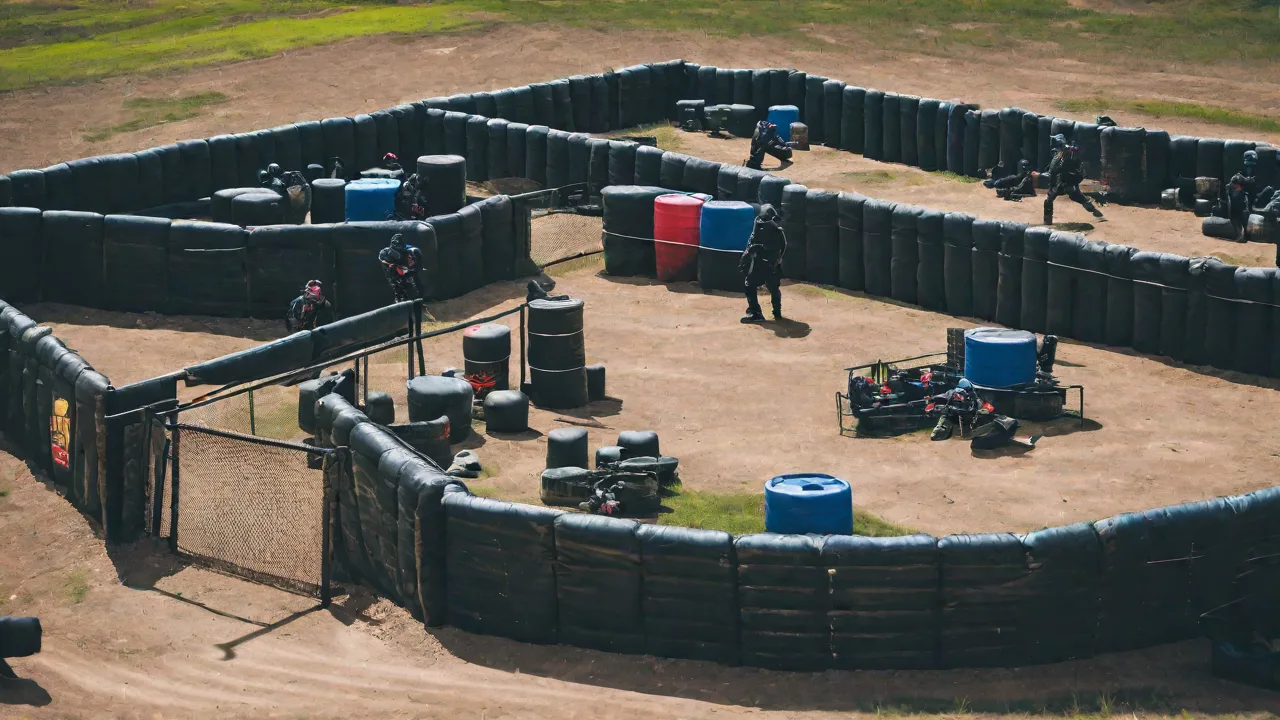
Speedball fields feature symmetrical inflatable bunkers arranged in a grid or patterned layout. The design is deliberately balanced, giving neither team a terrain advantage. Games are fast, with respawns allowed in the center or from the back line, and matches often last three to five minutes. Speedball demands quick reflexes, communication, and the ability to read opponent movements. The National XBall League (NXPL) and other tournament circuits use standardized field dimensions and bunker sets to ensure consistency across events (source: Paintball Players Association).
While speedball fields can feel repetitive if played on the same layout every session, smart operators rotate between three or four bunker configurations. This keeps regular players engaged while still maintaining the symmetrical balance needed for practice. Speedball fields are best for 3-on-3, 5-on-5, or 7-on-7 formats, and they draw the most dedicated competitive players. Adding a pit area with air stations and a visible scoreboard turns the field into a spectator-friendly environment that builds community energy.
The Hybrid Field – Blending Natural and Man-Made Elements
The hybrid field combines inflatable bunkers, wooden structures, and natural cover in a single layout. This approach offers the best of both worlds: the visual appeal and tactical depth of natural terrain with the balanced, competitive feel of speedball. Hybrid fields are particularly effective for large group events and scenario games where teams of 20 or more players need varied engagement opportunities. The key to a successful hybrid is transition zones. Areas where the terrain shifts from open wooded sections to tight urban-style corridors force players to adapt their tactics on the fly.
A well-known hybrid facility is Skirmish USA in Pennsylvania, which blends wooded areas with themed buildings, bunkers, and even a recreated Middle Eastern village (source: Skirmish USA). Their fields attract up to 500 players for weekend scenario events. Hybrid fields require more maintenance than pure speedball or woodsball setups, but the return on engagement is significant because every game feels like a different environment.
The Scenario Field – Story-Driven Gameplay
Scenario fields are designed around a narrative, often with multiple objectives that evolve as the game progresses. These fields are the most complex to design and build, but they produce the highest sustained engagement levels, especially for recurring events. Scenario fields include props, themed buildings, and sometimes pyrotechnics or smoke machines. The layout must support multiple simultaneous objectives, such as capturing a flag, activating a switch, rescuing a teammate, or securing a supply cache. Good scenario design creates a story arc within a single game, with phases that escalate tension.
For instance, a mission might begin with teams needing to locate a hidden briefcase in the field, then defend their extraction point for five minutes, and finally eliminate all opposing players. Each phase changes the spatial focus of the field, preventing any single area from becoming static. Scenario fields can handle player counts from 30 to over 200, and games can run from 30 minutes to several hours. The investment in set design and props pays off in player loyalty and word-of-mouth marketing.
Advanced Design Strategies for Sustained Engagement
Beyond choosing a layout archetype, field designers can apply several advanced strategies to keep engagement levels high across multiple visits by the same players. These strategies focus on variety, adaptability, and feedback-driven iteration.
Multi-Level Engagement and Verticality
Adding vertical elements like towers, raised platforms, and second-story windows creates tactical opportunities that flat fields cannot match. A player who controls a high position can dominate a large area, but they must expose themselves to clear those shots. This risk-reward dynamic is inherently engaging. Vertical elements also create natural chokepoints around ladders and stairways, generating intense close-quarters fights. For safety reasons, all elevated positions should have railings at least 42 inches high, and fall protection should comply with ASTM F2220 standards for paintball fields.
Dynamic Objective Placement
Static objectives become predictable after a few games. Dynamic objectives that change location, value, or rules force players to constantly reassess their strategy. One effective technique is the "moving flag" rule: after a team scores, the flag or objective is moved to a new location on the field for the next round. Some fields use electronic systems that randomly activate different target zones, creating real-time shifts in the tactical landscape. This unpredictability maintains mental engagement even for experienced players.
Rotating Layouts and Modular Bunkers
Fields that use modular bunkers, whether inflatable or built from lightweight panels, can reconfigure their layout in under 30 minutes. Renting two sets of bunkers and switching between them on alternating weekends keeps the field fresh for regulars. Some operators schedule a monthly "layout night" where players vote on the next configuration. This involvement builds community investment and gives players ownership over their playing environment. Speedball teams particularly appreciate the ability to practice on layouts that mimic upcoming tournament fields.
Player Feedback Loops and Field Iteration
The most successful field operators collect player feedback after every session. Simple questions like "Which area of the field saw the most action?" and "Did you feel there was a safe route to the objective?" provide actionable data. If players consistently bypass a certain bunker or avoid a specific lane, that zone needs redesign. Over several months of iteration, a field can evolve from a generic layout to a finely tuned engagement machine. Tracking metrics like average game time, elimination rate, and return player percentage helps quantify the impact of changes.
Safety, Accessibility, and Maintenance Considerations
No field layout, no matter how engaging, can succeed if it does not prioritize safety and accessibility. These factors directly affect player retention and liability management.
Field Safety Protocols
Every field must have clearly marked safe zones, chronograph stations, and emergency exits. Obstacles should be securely anchored and free of sharp edges. All structures used as cover must be stable enough to withstand players leaning against them during active gameplay. Fields should be inspected weekly for damage, especially after rain or heavy use. Safety netting or barrier fencing must be a minimum of 10 feet high around all playing areas to keep paintballs contained. This is not just a best practice - it is a requirement for insurance coverage in most regions.
Accessibility for All Skill Levels
An engaging field is one that players of different experience levels can enjoy. Designing with accessibility means creating multiple routes to every objective. An experienced player might take a risky flank through open ground, while a beginner can advance through heavy cover. Fields should also accommodate players with physical limitations by avoiding steep inclines where possible and providing wide enough lanes for wheelchair users to navigate. Many top fields offer "rental only" areas with simpler layouts that reduce confusion and frustration for first-time players.
Long-Term Field Maintenance
Engagement drops quickly when fields become shabby. Inflatable bunkers develop leaks, wooden structures rot, and natural cover gets trampled. A maintenance schedule that includes patching bunkers monthly, replacing rotten wood annually, and replanting trampled vegetation every spring keeps the field looking professional and playing safely. Some operators designate a "field day" each month where players volunteer to help with repairs in exchange for free play. This builds community and reduces labor costs simultaneously.
Measuring Engagement and Field Performance
To know whether a layout truly maximizes engagement, field operators should track specific metrics and benchmark against industry standards.
Key Metrics for Field Success
The most important metrics include average game time, return rate of players, and rating survey scores. A healthy speedball field should see average game times between 4 and 7 minutes. Woodsball and scenario fields should fall in the 12 to 25 minute range. If games are consistently ending too quickly, the field may favor one side or lack sufficient cover. If games drag on, the objective may be too hard to reach or the field may have too many hiding spots. Return rate is the gold standard for engagement: fields that see over 60 percent of players returning within three months are doing something right. Online reviews and comment cards provide qualitative data that numbers alone cannot capture.
Case Studies from Top Facilities
Several paintball facilities in North America have invested heavily in field design research. Paintball Waco in Texas publishes their field statistics on their website, showing an average player return rate of 72 percent over the past three years (source: Paintball Waco). Their strategy includes rotating layouts every six weeks and surveying players after each major event. CPX Sports in Chicago runs multiple fields with hybrid designs that achieve an average game time of 9 minutes across all modes. They attribute their high engagement to a 50:50 cover-to-open-space ratio and a policy of having at least two active objectives at all times. These case studies demonstrate that intentional design combined with data collection produces measurable results.
Conclusion – Building Fields That Keep Players Coming Back
Designing a paintball field that maximizes player engagement is not about following a single blueprint. It is a continuous process of understanding player psychology, observing real gameplay, and iterating on layout choices. The best fields balance cover and open space, incorporate verticality and thematic elements, and provide clear objectives that evolve over time. Whether you are building an urban arena for close-quarters action, a woodsball field for stealth operations, a speedball layout for competitive play, or a hybrid scenario field for large events, the principles remain the same: design for flow, prioritize safety, and listen to the people who play on the field every weekend. A layout that challenges players without frustrating them, that rewards teamwork without punishing individual skill, and that changes enough to stay fresh but remains familiar enough to learn is a layout that builds a loyal community. That is the foundation of engagement that stands the test of time.