Table of Contents
Selecting the right paintball hopper can make or break your performance on the field. While markers and masks often steal the spotlight when players upgrade their gear, experienced paintballers know that a reliable loader is the unsung hero of consistent shooting. A hopper that jams mid-firefight, feeds too slowly for your marker's rate of fire, or dumps paint during a dive can transform a sure elimination into a frustrating defeat.
This comprehensive guide examines the best paintball hoppers available in 2025, breaking down everything from budget-friendly gravity-fed options to tournament-grade electronic loaders that professional players trust. Whether you're stepping onto the speedball field for the first time or optimizing your competitive loadout, you'll find detailed analysis of features, specifications, and real-world performance to help you make an informed decision.
Why Your Paintball Hopper Matters More Than You Think
The paintball hopper, also called a loader, sits atop your marker and serves one critical function: delivering paintballs into the firing chamber consistently and quickly enough to keep pace with your trigger finger. This seemingly simple task becomes remarkably complex when you're shooting 15-30 balls per second, diving behind bunkers, or playing in adverse weather conditions.
Feed rate represents the most discussed hopper specification, measured in balls per second (BPS). During the "arms race" era of paintball's first decade, manufacturers pushed feed rates higher and higher as electronic markers achieved increasingly ridiculous rates of fire. Modern tournament regulations have since capped fire rates at 10.5 BPS for most competitive formats, meaning today's high-end hoppers possess feed capabilities far exceeding what most players actually need. However, feed rate consistency remains crucial—a hopper that can theoretically feed 30 BPS but occasionally hesitates will cause chopped paint and missed shots.
Anti-jam technology has become standard on quality loaders, but implementations vary significantly. Some hoppers use sensor-based systems that detect jams and reverse the feed mechanism. Others rely on flexible drive fingers that physically prevent balls from wedging. The best loaders combine multiple approaches to virtually eliminate jamming under all conditions.
Capacity typically ranges from 180 to 280 paintballs for standard hoppers. Higher capacity means less frequent reloading during extended games but adds weight and profile height. Many players prefer smaller, lighter hoppers for speedball while woodsball players often favor maximum capacity for scenarios where resupply opportunities are limited.
Durability determines how well your loader survives the inevitable impacts, drops, and dives that paintball demands. Premium hoppers use glass-filled nylon shells that resist cracking, while budget options may employ polycarbonate that becomes brittle over time.
Types of Paintball Hoppers Explained
Understanding the fundamental differences between hopper types helps narrow your search to options that match your playing style and budget.
Gravity-Fed Hoppers
Gravity-fed hoppers represent paintball's original loading technology. These simple designs rely entirely on gravity to drop paintballs from the hopper body through the feed neck and into the marker's firing chamber. No batteries, motors, or electronics complicate the operation—paintballs simply fall when space becomes available.
The advantages of gravity-fed hoppers include zero maintenance requirements, no battery concerns, lightweight construction, and extremely affordable pricing. Quality gravity-fed options like the Proto Primo cost under $20 and provide reliable service for years.
However, gravity-fed hoppers max out at roughly 8-12 balls per second under ideal conditions. Shooting faster causes "ball stacking" where multiple paintballs attempt to enter the feed neck simultaneously, leading to jams that require shaking to clear. This limitation makes gravity hoppers unsuitable for electronic markers or aggressive semi-automatic shooting.
Gravity-fed hoppers work best for pump markers, recreational mechanical markers, and players who prioritize shot accuracy over volume. Many pump players specifically choose gravity hoppers to maintain a lightweight, low-profile setup.
Agitating Hoppers
Agitating hoppers add a motorized paddle or propeller system that stirs paintballs within the hopper body, helping them funnel toward the feed neck more efficiently than gravity alone allows. A sensor—typically sound-activated or vibration-based—detects when the marker fires and activates the agitation motor.
This technology bridges the gap between basic gravity feeding and full force-feed systems. Agitating hoppers achieve feed rates around 12-18 BPS depending on the specific design, sufficient for mechanical markers and some electronic setups at recreational rates of fire.
The Empire Halo Too exemplifies modern agitating hopper design, combining a sound-activated belt drive with the Freeway Anti-Jam system to deliver 20+ BPS while preventing paint damage. At roughly $75-85, agitating hoppers offer significant performance improvements over gravity-fed options without the premium pricing of force-feed loaders.
Force-Fed Electronic Hoppers
Force-fed electronic hoppers represent the pinnacle of loader technology. Rather than simply helping paintballs fall faster, force-feed systems actively push paintballs into the marker's feed neck, ensuring the chamber receives ammunition regardless of hopper angle or shooting intensity.
Modern force-fed hoppers employ sophisticated sensor arrays that detect paint movement throughout the feed stack. Advanced models from Virtue, Dye, and HK Army use infrared sensors, accelerometers, or laser break-beam systems to precisely control when and how aggressively the feed mechanism engages. This intelligence allows the loader to respond instantly when you start shooting while avoiding unnecessary motor operation that wastes battery life.
Premium force-fed hoppers feed 25-30+ BPS consistently, handle brittle paint without breaking shells, and virtually eliminate jamming through flexible drive systems. Professional players universally use force-fed loaders, and serious recreational players find the investment worthwhile for the dramatic reliability improvement.
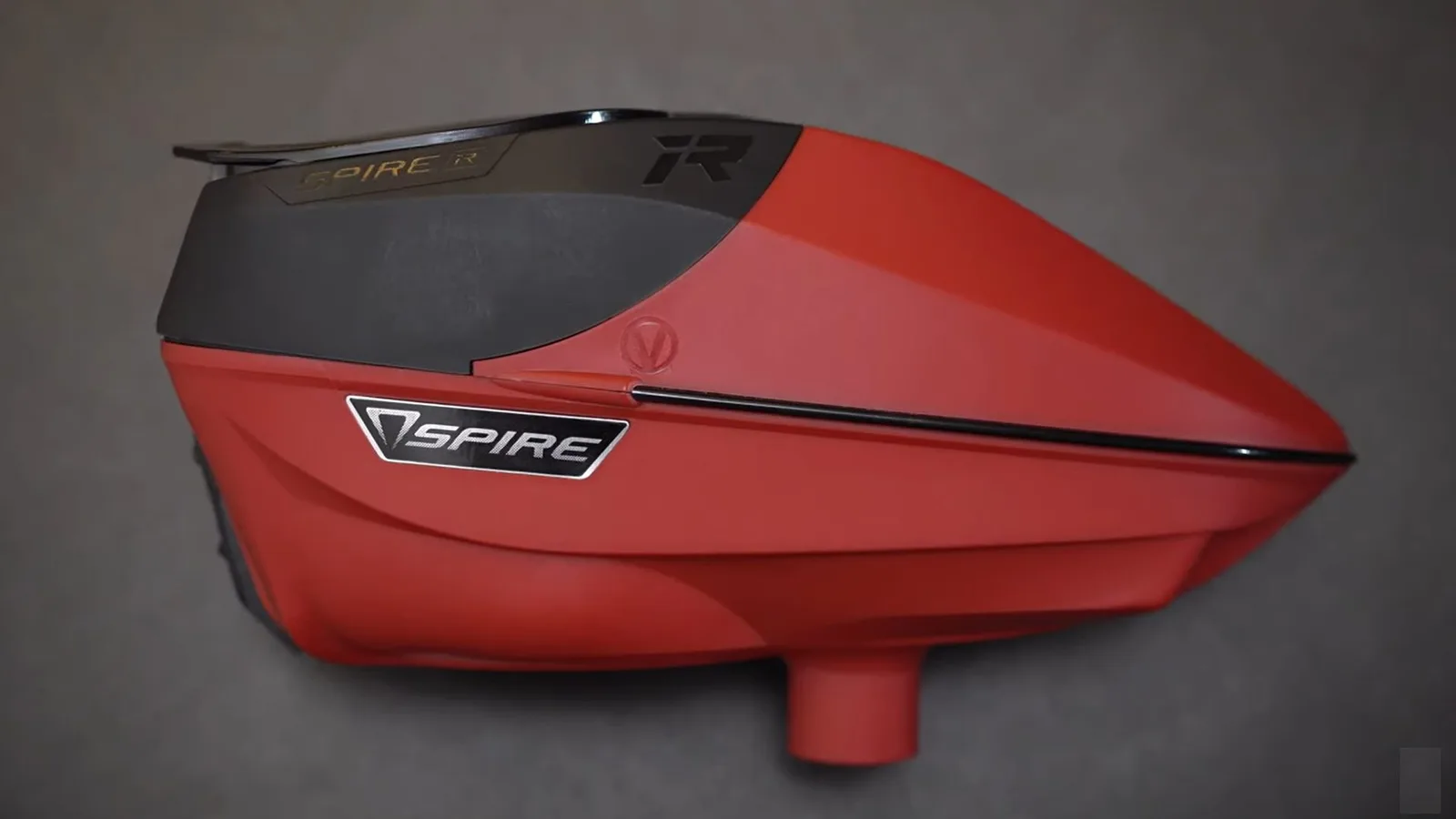
Pricing ranges from $100 for entry-level force-fed options like the Virtue Spire IR2 up to $250+ for flagship models with all available features.
Best Electronic Paintball Hoppers
Virtue Spire V – Best Overall Performance ($200-220)
The Virtue Spire V represents over a decade of refinement to the winningest hopper platform in professional paintball history. Virtue's engineering team redesigned the electronics from the ground up, incorporating three infrared sensors working alongside an accelerometer to control precise paint feeding throughout the shooting cycle.
Dual sensor technology allows the Spire V to simultaneously monitor both shot detection and ball detection within the feed stack. This comprehensive awareness enables real-time jam detection with immediate response—the hopper alerts you to problems and clears them before they affect gameplay.
Key Features:
- 230+ round capacity (280 with high-cap shell)
- Dual-sensor technology (IR sensors + accelerometer)
- Toolless Spire drive and tray removal
- Included CrownSF III Speed Feed and rain lid
- Glass-filled nylon construction
- Upgraded dual shell lock system
- Up to 20,000 shots per battery charge
The Spire V's hinged shell design allows quick access for reloading and maintenance. Push a tactile button to open the lid, and the latching mechanism keeps everything secure during gameplay. Individual components remove easily with one hand, making field cleaning practical between games.
Virtue includes a color-matched CrownSF III speed feed and rain lid with every Spire V, eliminating the need for immediate accessory purchases. The speed feed's spring fingers enable rapid reloading while preventing paint spillage during movement, and the rain lid swaps in seconds when weather conditions warrant full coverage.
The Spire V's soft rubber drive fingers handle even brittle tournament-grade paint without breaking shells. Combined with the proactive feeding logic that engages the drive system only when needed, paint stays pristine from hopper to barrel.
Who Should Buy It: Tournament players seeking maximum reliability and professional-grade features. Recreational players who want the best available technology and don't mind the premium investment.
Dye R2 Rotor – Best Adjustable Capacity ($190-210)
The Dye R2 introduced an industry-first feature that remains unique: on-the-fly capacity adjustment between 200 and 260 rounds without requiring additional shells, parts, or tools. This revolutionary patent-pending shell design lets players optimize their loadout based on game format and personal preference.
Dye's Patented Rotor Force Fed Technology powers the R2's feeding mechanism, delivering 30+ balls per second while maintaining battery life exceeding 100,000 shots on three AA batteries. The constant-feed carousel combined with opposing rotation of the rotor center arm ensures paintballs enter the marker smoothly and consistently.
Key Features:
- Adjustable capacity: 200 or 260 rounds on-the-fly
- 30+ BPS feed rate with Rotor Force Fed Technology
- 100,000+ shot battery life (3 AA batteries)
- 20% larger mouth opening than R1 model
- Rapid Release quick-change lid system
- Electronic Dynamic Force Control for gentle paint handling
- Reload Alert System with low battery indicator
- Shark Fin jam release trigger
The R2's completely redesigned Quick Feed system allows effortless changes between the rain lid and optional Quick Feed accessory without tools. The 20% larger mouth opening compared to previous Rotor models makes reloading easier while keeping your eyes on the game.
Electronic Dynamic Force Control represents a significant advancement in paint handling. The circuit board logic regulates feed mechanism power to provide consistent initial feeding while automatically adjusting to a gentler touch when paint reaches the stack. This intelligence prevents paint damage without sacrificing feed speed.
The patent-pending Shark Fin jam release trigger provides manual intervention for the rare cases when oversized or out-of-round paint causes feeding issues. One quick press clears obstructions and returns you to full-speed shooting.
Who Should Buy It: Players who switch between game formats requiring different capacities, back players who want maximum paint carrying ability, or anyone who values the legendary Rotor platform's reliability.
Dye LT-R – Best Mid-Range Value ($95-110)
The Dye LT-R (Light Rotor) brings the proven Rotor platform's performance to players who don't need adjustable capacity or the R2's premium features. Internally, the LT-R uses the same fundamental technology that made the original Rotor a game-changer: constant-feed carousel, opposing-rotation center arm, and the patented force-feed mechanism that defined modern hopper standards.
Dye designed the LT-R as a stripped-down version of the original Rotor, removing features that added cost without affecting core feeding performance. The result delivers tournament-capable reliability at a price point accessible to intermediate players and budget-conscious competitors.
Key Features:
- 200-round capacity
- 30+ BPS feed rate
- 80,000+ shot battery life (3 AA batteries)
- Toolless disassembly
- Sharkfin anti-jam release trigger
- Adjustable torque settings
- Black Ops mode (LED indicator disable)
- Low battery indicator
The LT-R's toolless design allows complete breakdown for cleaning without any tools—simply slide the locking tab and the shell separates. This accessibility makes maintenance practical between games and thorough cleaning simple at home.
Adjustable torque lets users fine-tune feed tension using an Allen wrench, optimizing performance for different paint quality levels. Increase tension for maximum speed with quality paint or reduce it for gentler handling of brittle shells.
Battery efficiency rivals far more expensive hoppers. Three AA batteries power 80,000+ shots, meaning most players go an entire season or more between battery changes during typical weekend play.
Who Should Buy It: Intermediate players upgrading from gravity or agitating hoppers, budget-conscious tournament players, or anyone who wants proven Rotor reliability without premium pricing.
Virtue Spire IR2 – Best Budget Force-Feed ($120-130)
The Virtue Spire IR2 delivers Spire-platform reliability at nearly half the cost of flagship models. Building on an established design with proven field results, the IR2 provides professional-grade feeding performance that outperforms many more expensive competitors.
Virtue's Intelligent Proactive feeding system distinguishes the IR2 from traditional reactive loaders. Three IR sensors protected behind polycarbonate constantly monitor the paint stack, feeding proactively rather than waiting for shots to trigger the mechanism. This ensures a constant stream of paint regardless of shooting cadence or hopper angle.
Key Features:
- 200-round standard capacity (260 with expansion)
- 3-IR sensor proactive feeding technology
- Never jams or pulses
- Durable nylon toolless shells
- Quick-change lid for speed feed compatibility
- Compatible with Virtue N-Charge battery pack
- Soft flexible rubber drive fingers
- 9-ball raceway for consistent high-ROF feeding
The IR2 never pulses—a significant advantage over older agitating designs that create noise potentially alerting opponents to your position. The proactive feeding logic engages smoothly and quietly, maintaining stealth while ensuring reliable ammunition delivery.
Toolless construction means the entire hopper disassembles for cleaning without any tools. The slide-to-unlock mechanism on the shell provides quick access, and the tray lifts out for thorough maintenance. Speed feeds install in seconds, and the IR2 accepts the same accessories as higher-tier Spire models.
Glass-filled nylon shells provide durability matching more expensive options. The redesigned back shell uses this material throughout, eliminating the cheap plastic construction that plagued earlier budget loaders.
Who Should Buy It: Players seeking high-end performance without high-end pricing, recreational players who want reliability without overspending, or backup hopper for tournament players.
HK Army TFX 3.0 – Best Feature Set ($230-250)
The HK Army TFX 3.0 packs more features into a single loader than perhaps any competitor. HK Army combined updated technology with premium inclusions to create a comprehensive package that requires no immediate accessory purchases.
The TFX 3.0's Break Beam Laser Eye System drives the patented Swoop Stack assembly, activating feeding as paintballs leave the stack. When the laser sensors detect paint movement, the assembly continuously drives balls forward into the marker. A three-layer slip system enables Soft Touch Paddles to effectively agitate and loosen potential jams while feeding continues uninterrupted.
Key Features:
- 230+ round capacity (with expansion ring)
- Laser Break Beam Eye sensor system
- Soft Touch Paddle feeding system
- Included rechargeable lithium-ion battery
- Included Epic Speed Feed and rain lid
- USB-C charging port
- Water-resistant electronics
- Combat Contour low-profile shell
- 22+ BPS average feed rate
- QuickLid one-button lid changing
The Swoop Stack operates flawlessly with all paint types—oily, dimpled, brittle, and even Reball or other reusable paintballs. This versatility makes the TFX 3.0 equally capable at practice sessions and tournament competition.
HK Army includes a rechargeable lithium-ion battery and USB-C charging cable, eliminating ongoing battery costs. The battery pack provides enough power for 15+ cases of paint on a full charge, and recharging between play sessions ensures you're always ready.
The Combat Contour shell design creates an extremely sleek, low-profile silhouette while maintaining large capacity. High-grade impact-resistant material withstands abuse during aggressive play, and water-resistant electronics keep you shooting through rain or snow.
Who Should Buy It: Players who want a complete package with all accessories included, those who prefer rechargeable batteries over disposables, or anyone attracted to HK Army's aggressive styling.
Empire Halo Too V2 – Best Entry-Level Electronic ($75-85)
The Empire Halo Too has earned its position as the go-to entry-level electronic hopper through two decades of proven reliability. The V2 iteration refines an already excellent design with improved battery access and updated aesthetics while maintaining the affordable pricing that made the original a bestseller.
Sound-activated feeding triggers the ultra-quiet belt drive when the marker fires, delivering 20+ balls per second to keep pace with electronic markers and fast trigger fingers. The Freeway Anti-Jam system prevents paint stacking and broken balls, allowing continuous shooting while competitors shake their jammed hoppers.
Key Features:
- 180-round capacity
- 20+ BPS feed rate
- Ultra-quiet belt drive mechanism
- Sound-activated feeding
- Freeway Anti-Jam technology
- Rip Drive manual unjam wheel
- Programmable settings (motor speed, mic sensitivity)
- Tool-less battery door
- Low battery indicator
- 1-hour auto shut-off
The Rip Drive external gear wheel provides manual intervention if jams occur. Reach up and spin the wheel to clear obstructions without opening the hopper—a lifesaver during intense firefights when stopping to diagnose loader problems isn't an option.
Programming options let players customize motor speed and microphone sensitivity to optimize performance for their marker and playing style. The onboard computer manages these settings with simple button combinations.
Tool-less battery access represents a major V2 improvement. Previous Halo versions required partial disassembly to change batteries—a frustrating limitation addressed by the redesigned battery door that pops open with a button press.
Who Should Buy It: New players upgrading from rental equipment, recreational players seeking affordable reliability, or tournament players needing a dependable backup.
Bunkerkings CTRL 2 – Best Low Profile ($180-200)
The Bunkerkings CTRL 2 builds upon the original CTRL's reputation as the smallest, lightest 200-round loader in paintball. Weighing just 14.4 ounces and featuring an ultra-compact design, the CTRL 2 provides a dramatically better sight picture than bulkier competitors.
Bunkerkings licenses Spire technology from Virtue but implements significant enhancements. The CTRL 2's redesigned drive system replaces the drive cone with a torque-increasing drive hub for improved off-the-break performance. Shoot faster out of the gate and reload every last ball from pods easier with the roomier interior design.
Key Features:
- 220-round standard capacity
- Compact Drive Hub feeding system
- Pulse-Free Three-Eye feeding logic
- Industry-first Angle Indicator (training feature)
- Magnetic tray for toolless disassembly
- Upgraded shell and tray locks
- Glass-filled nylon shell construction
- Removable eye covers for easy cleaning
- Compatible with CTRL accessories and N-Charge battery
The CTRL 2's Three-Eye feeding logic activates as soon as shooting begins and continues until the feed stack reaches capacity. This pulse-free operation maintains stealth while ensuring reliable feeding regardless of shooting cadence or marker angle.
The Angle Indicator—an LED light bar on the hopper's rear—represents a unique training feature. Calibrated for regulation tournament field dimensions, it helps players dial in their breakout shots through home practice sessions. While not used during actual gameplay, this training aid helps develop muscle memory for those critical first-shot eliminations.
Perfectly balanced weight distribution means the CTRL 2 feels natural on any marker. Whether running, diving, or snap-shooting, the loader stays stable without creating the back-heavy feel that larger hoppers produce.
Who Should Buy It: Players prioritizing sight lines and minimal profile, tournament players seeking every competitive edge, or those who value the training features for improvement.
Protoyz Speedster – Best Budget Electronic ($60-70)
Planet Eclipse's Protoyz sub-brand developed the Speedster specifically for budget-conscious players and paintball park owners seeking affordable electronic feeding. Despite the entry-level pricing, the Speedster delivers legitimate electronic performance through proven technology.
The Light Barrier feeding system uses eye sensors to detect when the marker fires, activating the large agitator paddle to feed paint accordingly. This approach achieves 10+ BPS feed rates—sufficient for mechanical markers and many electronic setups at recreational rates of fire.
Key Features:
- 210-round capacity (68 cal) / 500 rounds (50 cal)
- 10+ BPS feed rate
- Glass-Fiber-Reinforced Nylon (GRN) construction
- 100% toolless assembly and disassembly
- Dual-caliber capability (adapter included)
- Light barrier sensor technology
- 4 AA battery power
- Illuminated on/off button
- Low power consumption
Dual-caliber capability sets the Speedster apart from other budget options. The included 50-cal adapter plugs into the Light Barrier unit, converting the loader to accommodate low-impact paintball. Parks offering both standard and low-impact games appreciate this versatility.
GRN construction creates remarkably tough shells for the price point. The material resists cracking even under abuse that would shatter cheaper polycarbonate housings. The shells separate into top and bottom halves for cleaning—completely toolless like far more expensive loaders.
Who Should Buy It: Entry-level players wanting electronic feeding without premium pricing, paintball park operators equipping rental fleets, or recreational players seeking a reliable upgrade from gravity-fed hoppers.
Best Gravity-Fed Hoppers
Proto Primo – Best Gravity-Fed Overall ($15-20)
The Proto Primo revolutionized gravity-fed hoppers with its patent-pending Positive Feed Shelf—an internal design feature that dramatically reduces jamming while improving feed rates. Traditional gravity hoppers stack balls directly over the feed neck, creating pressure that causes jams. The Primo's shelf relieves this pressure while funneling paint smoothly toward the marker.
Key Features:
- 200-round capacity
- 8-12 BPS feed rate (with minimal agitation)
- Positive Feed Shelf anti-jam design
- Clear spring-loaded lid
- Large opening compatible with Proto Alpha Pods
- Durable shell construction
- No batteries required
The clear spring-loaded lid allows quick paint level checks while providing easy reloading access. The large opening works particularly well with Proto Alpha pods for efficient resupply.
Field testing consistently shows the Primo outperforms standard gravity hoppers by a significant margin. The shelf design virtually eliminates the ball stacking issues that plague basic gravity-fed loaders, allowing feed rates approaching electronic agitating hoppers under ideal conditions.
Who Should Buy It: Pump players seeking lightweight simplicity, recreational players on tight budgets, backup hopper for any player, or those using mechanical markers at moderate fire rates.
Hopper Accessories and Upgrades
Speed Feeds
Speed feeds replace standard hopper lids with one-way gates that allow rapid reloading without opening a lid. Flexible fingers or arms permit paintballs to enter from pods while preventing spillage during movement, diving, or inverted shooting angles.
Quality speed feeds halve reload time compared to traditional lids, making them essential for competitive play. Most electronic hoppers accept brand-specific or universal speed feeds as direct replacements.
Popular options include:
- Virtue CrownSF Series: Spring-loaded fingers with individual removal tabs
- Bunkerkings NTR Speed Feed: Flexible nylon fingers co-molded with ultrasoft elastomer
- HK Army Epic Speed Feed: Universal fit for multiple hopper brands
- Dye Rotor Quick Feed: Magnetic dual-density arms with living hinge system
- Exalt Fast Feed: Budget-friendly universal option
Most high-end hoppers include speed feeds in the box, but replacements and upgrades remain popular accessories. Match your speed feed choice to your playing style—aggressive players benefit from faster-opening designs while those prioritizing paint retention choose firmer springs.
Rain Lids
Rain lids provide full coverage over the hopper opening, protecting paint from moisture during wet weather play. While speed feeds work adequately in light rain, heavy downpours can waterlog paintballs and cause feeding issues.
Most hoppers include rain lids alongside speed feeds, and switching between them takes seconds. Smart players bring rain lids to every event, even when forecasts predict clear skies.
Spring Ramps
Spring ramps install inside the hopper shell, using spring tension to push the last paintballs toward the feed stack. Without ramps, the final 10-20 paintballs may not feed reliably at certain angles—particularly problematic during extended gunfights when every shot counts.
Virtue, Bunkerkings, and other manufacturers offer spring ramps as optional accessories. Some hoppers include them standard while others require separate purchase.
Rechargeable Battery Packs
Rechargeable battery packs replace standard AA or 9V batteries with lithium-ion alternatives. The Virtue N-Charge works across multiple hopper platforms, providing convenient USB charging between sessions.
Benefits include long-term cost savings, consistent power delivery, and environmental friendliness. However, players must remember to charge between events—unlike disposable batteries that work immediately from the package.
Gravity-Fed vs Electronic Hoppers: Making the Right Choice
The decision between gravity-fed and electronic hoppers depends on your marker, playing style, and budget priorities.
Choose gravity-fed hoppers if:
- You use a pump marker
- You primarily play recreational games at moderate fire rates
- Budget constraints prevent electronic hopper investment
- You value simplicity and zero maintenance
- Weight and profile minimization matter more than feed speed
- Your marker's rate of fire stays below 10 BPS
Choose electronic hoppers if:
- You use an electronic marker
- You play speedball or competitive formats
- Reliable feeding matters more than initial cost
- You shoot aggressively and need consistent feed rates
- Paint efficiency concerns you (choppers waste paint)
- You want anti-jam features to prevent mid-game problems
The price difference between quality gravity hoppers ($15-20) and entry-level electronic options ($60-85) represents a relatively small investment given paintball's overall equipment costs. Most players find electronic hoppers worth the upgrade once they experience the reliability improvement firsthand.
Speedball vs Woodsball Hopper Considerations
Playing format influences ideal hopper selection beyond basic feed rate requirements.
Speedball Priorities
Speedball's short, intense games demand maximum reliability during brief windows of opportunity. Features that matter most:
- Low profile: Smaller hoppers improve sight lines over bunkers
- Lightweight design: Reduces fatigue during constant movement
- High feed rates: Supports aggressive shooting volume
- Quick reload capability: Speed feeds become essential
- Durability: Survives slides and impacts on artificial turf
Tournament speedball players typically choose high-end force-feed hoppers like the Virtue Spire V, Dye R2, or Bunkerkings CTRL series. The investment makes sense when equipment reliability directly affects competitive outcomes.
Woodsball Priorities
Woodsball's longer games with limited resupply opportunities shift priorities:
- High capacity: Maximum paint carrying between reloads
- Battery efficiency: Extended battery life for all-day scenarios
- Weather resistance: Performance in rain, mud, and debris
- Physical durability: Survives brush, falls, and environmental hazards
- Stealth: Quiet operation avoids alerting opponents
The Dye R2's adjustable capacity feature appeals to woodsball players who want 260-round capacity for scenario games. The Virtue Spire series' excellent battery life supports extended play sessions without concern.
Hopper Maintenance and Care
Proper maintenance extends hopper life and ensures consistent performance. Establish these habits for reliable service.
Post-Game Cleaning
After every playing session:
- Remove remaining paintballs from the hopper body
- Check for broken paint inside the shell and feed mechanism
- Wipe exterior surfaces with a damp microfiber cloth
- Inspect the feed neck for paint residue
- Remove batteries if storing for extended periods
Quick cleaning prevents paint residue from drying and becoming difficult to remove. Five minutes of attention after each game prevents hours of intensive cleaning later.
Deep Cleaning
Perform thorough cleaning monthly for regular players or after any paint break inside the hopper:
- Disassemble completely following manufacturer instructions
- Remove drive components (cone, fingers, tray)
- Wash all parts with warm water and mild soap
- Clean sensors carefully with soft cloth or Q-tips
- Dry everything thoroughly before reassembly
- Check O-rings and seals for wear
- Verify electronic connections remain secure
- Test operation before next use
Use only soft materials when cleaning. Abrasive brushes or cloths can scratch sensors, damage drive fingers, or mar shell surfaces.
Storage Best Practices
Proper storage prevents damage between sessions:
- Remove all paintballs before storage (paint deteriorates and creates residue)
- Take out batteries for long-term storage (prevents corrosion)
- Store in cool, dry location away from direct sunlight
- Use protective cases or bags for transport
- Avoid extreme temperatures that can warp plastics
- Keep separate from markers with compressed air attached
Troubleshooting Common Issues
Hopper won't turn on:
- Check battery installation (correct polarity)
- Test with fresh batteries
- Clean battery contacts
- Verify power switch functionality
Paint breaks inside:
- Reduce feed tension if adjustable
- Check for damaged drive fingers
- Ensure shells close completely
- Use fresher, higher-quality paint
Jamming occurs:
- Clean feed mechanism thoroughly
- Inspect drive cone/fingers for damage
- Verify sensors are clean
- Check for foreign debris
Feed rate seems slow:
- Replace low batteries
- Clean sensors
- Verify shell closes properly
- Check for worn drive components
How to Choose the Right Paintball Hopper
Navigate the selection process systematically to find your ideal loader.
Assess Your Marker
Your marker's capabilities establish minimum hopper requirements:
- Pump markers: Gravity-fed hoppers work perfectly
- Mechanical markers (8-12 BPS): Gravity or entry-level electronic
- Electronic markers (10.5 BPS cap): Quality electronic hopper recommended
- Uncapped electronic markers: High-end force-feed required
Matching hopper feed rate to marker capability prevents chopped paint while avoiding overspending on unnecessary performance.
Consider Your Playing Style
How you play influences which features matter most:
- Aggressive speedball: Prioritize reliability, low profile, quick reload
- Recreational play: Value and ease of use matter most
- Scenario/woodsball: Capacity and durability take priority
- Tournament competition: Maximum reliability justifies premium investment
Establish Your Budget
Realistic budget tiers and what each provides:
Under $25: Quality gravity-fed hoppers (Proto Primo) $60-85: Entry-level electronic (Protoyz Speedster, Empire Halo Too) $100-130: Mid-range force-feed (Dye LT-R, Virtue Spire IR2) $180-220: Premium electronic (Virtue Spire V, Dye R2, Bunkerkings CTRL 2) $230+: Feature-complete packages (HK Army TFX 3.0)
Spending more buys better materials, more sophisticated electronics, and enhanced features—but diminishing returns set in above the mid-range tier for recreational players.
Prioritize Compatibility
Verify any hopper you consider works with your setup:
- Feed neck fit: Universal fit works with most markers, but verify
- Speed feed compatibility: Ensure upgrades available for your choice
- Battery availability: AA batteries easier to find than 9V or proprietary
- Accessory ecosystem: Popular hoppers have more upgrade options
Frequently Asked Questions
How many paintballs does a hopper hold?
Standard hoppers hold 180-200 paintballs, while high-capacity options reach 260-280 rounds. The Dye R2 uniquely offers adjustable capacity between 200 and 260 without additional parts.
How fast should my hopper feed?
Your hopper should feed faster than your marker's rate of fire. For most tournament play capped at 10.5 BPS, any quality electronic hopper provides sufficient speed. Recreational players with mechanical markers can often use gravity-fed options successfully.
Do I need a speed feed?
Speed feeds aren't strictly necessary but significantly improve reload efficiency. Tournament players consider them essential, while recreational players may find standard lids acceptable. Many premium hoppers include speed feeds, eliminating the separate purchase decision.
How long do hopper batteries last?
Quality electronic hoppers achieve 50,000-100,000 shots per battery set, lasting most players an entire season or longer during typical weekend play. Budget options may require more frequent changes.
Can I use any hopper with any marker?
Most hoppers feature universal feed necks compatible with standard marker feeds. However, verify compatibility before purchase—some older or unusual markers may require specific adapters.
What causes paint to break in hoppers?
Paint breaks result from excessive pressure on shells, rough drive mechanisms, old/brittle paint, or mechanical damage. Quality hoppers with soft drive fingers and proper tension settings minimize breaks significantly.
Should I buy a backup hopper?
Tournament players should carry backup hoppers in case of failure. Recreational players may not need backups immediately but benefit from having one available as equipment ages.
How do I clean broken paint from my hopper?
Disassemble completely, remove visible shell pieces, wash all components with warm water and mild soap, dry thoroughly, and reassemble. Avoid using the hopper until completely dry to prevent additional feeding issues.
Are expensive hoppers worth the cost?
For tournament players where equipment reliability directly affects competitive outcomes, premium hoppers justify their cost. Recreational players receive excellent value from mid-range options that provide professional-grade reliability at accessible prices.
How often should I replace my hopper?
Quality hoppers last many years with proper care. Replace when shells crack, electronics fail, feed rates decrease noticeably, or jamming becomes frequent despite proper maintenance.
Final Recommendations
Selecting your paintball hopper comes down to matching your needs with available options at appropriate price points.
For tournament speedball players, the Virtue Spire V delivers the ultimate combination of reliability, features, and proven performance. Its decade of professional tournament success speaks for itself.
For players seeking value without sacrificing quality, the Dye LT-R provides legendary Rotor platform reliability at mid-range pricing. You get tournament-capable performance without premium cost.
For budget-conscious beginners upgrading from gravity, the Empire Halo Too offers two decades of proven design at accessible pricing. It's the natural first electronic hopper for developing players.
For pump and mechanical marker users, the Proto Primo represents the best gravity-fed option available, with its innovative Positive Feed Shelf dramatically outperforming basic gravity hoppers.
For players wanting maximum features and included accessories, the HK Army TFX 3.0 packages everything together with rechargeable power, premium speed feed, and aggressive styling.
Invest appropriately based on how seriously you play and how much reliability matters to your enjoyment. A hopper that feeds reliably every time becomes invisible during gameplay—exactly what you want when focusing on eliminating opponents rather than troubleshooting equipment.
Additional Resources
