Table of Contents
Paintball has evolved from a niche recreational activity into a mainstream sport enjoyed by millions of players across the United States. Whether you're drawn to the adrenaline rush of competitive speedball, the tactical challenges of woodsball, or simply want a fun way to spend time with friends, paintball offers an experience unlike any other outdoor activity. However, before you purchase your first marker or head out for a game, understanding the legal landscape surrounding paintball guns is essential.
The question "are paintball guns illegal?" doesn't have a simple yes or no answer. While paintball markers are legal to own and use throughout the United States, the specific regulations governing their purchase, possession, transportation, and use vary significantly depending on where you live. Federal law treats paintball guns differently than traditional firearms, but state and local ordinances can impose restrictions that catch uninformed players off guard.
This comprehensive guide examines paintball gun laws across the country, explains the legal distinctions between paintball markers and firearms, and provides practical guidance for staying compliant while enjoying this exciting sport.
Understanding Paintball Gun Classification Under Federal Law
At the federal level, paintball guns occupy a unique legal category that sets them apart from traditional firearms. The Bureau of Alcohol, Tobacco, Firearms and Explosives (ATF) maintains clear guidelines about what constitutes a firearm under federal law, and paintball markers fall outside this definition for specific technical reasons.
Why Paintball Guns Are Not Classified as Firearms
The ATF defines a firearm as any weapon designed to expel a projectile through an explosive action. This definition encompasses handguns, rifles, shotguns, and other weapons that use gunpowder or similar propellants to fire ammunition. Paintball guns operate on an entirely different mechanical principle, using compressed air or carbon dioxide to propel gelatin capsules filled with water-soluble dye.
Because paintball markers rely on pneumatic pressure rather than explosive combustion, they do not meet the federal definition of a firearm. This distinction has significant practical implications. Paintball guns are not subject to the same purchase restrictions, background check requirements, or registration mandates that apply to traditional firearms under federal law.
However, this federal classification does not give paintball gun owners unlimited freedom. The absence of federal firearm regulations simply means that governance falls to state and local authorities, many of which have enacted their own rules governing these devices.
The Imitation Firearm Distinction
Several states classify paintball guns as "imitation firearms" rather than weapons. This category typically applies to devices that resemble real firearms in appearance but lack the capability to fire lethal ammunition. The imitation firearm classification often triggers specific regulations about public display, transportation, and modification.
California provides the clearest example of this approach. Under California law, paintball guns qualify as imitation firearms because they bear visual resemblance to actual weapons and can fire projectiles. This classification imposes restrictions on where you can carry or display a paintball marker, even though the device itself remains legal to own and use in appropriate settings.
State-by-State Paintball Gun Regulations
Paintball gun laws vary dramatically across state lines, creating a patchwork of regulations that players must navigate carefully. Some states impose minimal restrictions beyond basic age requirements, while others treat paintball markers similarly to traditional weapons.
California's Comprehensive Paintball Regulations
California maintains some of the most detailed paintball gun regulations in the country. The state's classification of paintball markers as imitation firearms triggers several important restrictions that players must understand.
Public carry and display of paintball guns is prohibited throughout California. You cannot openly carry a paintball marker on public streets, public transportation, near government buildings, in shopping centers, or in most other public spaces. Violations can result in misdemeanor charges carrying fines and potential jail time.
The law permits paintball gun possession only in specific designated areas. These include licensed paintball facilities, theatrical productions using paintball guns as props, and private residences where owners choose to display or store their equipment. Transportation between these locations requires the paintball gun to be unloaded and stored in a case or container that prevents easy access.
Age restrictions in California require individuals to be at least 18 years old to purchase, own, or carry a paintball gun. Minors cannot legally possess paintball markers in the state, even with parental supervision or consent. Parents who provide paintball guns to children under 18 may face legal liability.
New Jersey's Weapon Classification Approach
New Jersey takes a stricter approach by classifying paintball guns as weapons under certain circumstances. The critical factor is context: a paintball marker used at a licensed field for recreational play is treated differently than one carried on public streets or used outside designated areas.
Carrying a paintball gun outside of a paintball facility without a clear recreational purpose can lead to weapons charges in New Jersey. The state's laws focus on intent and location, meaning the same device might be perfectly legal at a paintball park but constitute a criminal violation when transported improperly or used in unauthorized settings.
New Jersey also requires permits for paintball gun ownership in some circumstances. The application process typically involves identity verification, age confirmation, and address documentation. Some applicants may need to complete safety courses before obtaining approval.
New York's Regulatory Framework
New York classifies paintball guns as weapons in certain contexts, similar to New Jersey's approach. The state imposes registration requirements and age restrictions that exceed federal standards.
New York City maintains particularly strict regulations that go beyond state law. The city requires permits for many air-powered devices, including some paintball markers. Players planning to purchase, own, or use paintball guns in New York City should research local ordinances carefully before proceeding.
Upstate New York generally follows state regulations, which are less restrictive than city rules but still more stringent than many other states. Age requirements, transportation rules, and use restrictions apply throughout the state.
States with Minimal Paintball Restrictions
Many states impose relatively few restrictions on paintball gun ownership and use beyond basic age requirements. Texas, Florida, Arizona, and numerous other states treat paintball markers as sporting equipment rather than weapons, allowing adults to purchase and own them without permits or registration.
Even in permissive states, certain universal restrictions apply. Using a paintball gun to threaten or harm others constitutes assault regardless of the weapon classification. Discharging paintball markers in prohibited areas, damaging property, or engaging in reckless behavior can result in criminal charges under general public safety laws.
Age Requirements for Paintball Gun Purchase and Ownership
Age restrictions represent one of the most consistent elements of paintball gun regulation across the United States. While specific requirements vary by state, most jurisdictions impose minimum age limits for purchase and sometimes for possession or use.
The 18-Year Minimum Standard
The majority of states require purchasers to be at least 18 years old to buy a paintball gun from a retail store. This standard aligns with many other age-restricted products and reflects concerns about maturity, responsibility, and safety judgment.
Retailers typically verify age through government-issued identification before completing paintball gun sales. Online purchases may involve age verification during checkout or require signature confirmation upon delivery to ensure compliance with state laws.
Parental Consent Provisions
Some states allow minors to purchase paintball guns with parental consent, creating pathways for younger players to own equipment for supervised recreational use. These provisions typically require a parent or legal guardian to be present during the purchase and may involve signing consent forms or providing written authorization.
Even in states permitting minor purchases with consent, restrictions often apply to unsupervised use or public possession. Parents providing paintball guns to minors should understand the full scope of applicable regulations to avoid inadvertent violations.
Field Play Age Requirements
Age requirements for playing paintball at commercial facilities often differ from purchase restrictions. Many paintball parks allow players as young as 10 or 12 to participate with parental consent, even in states where minors cannot own paintball guns.
These field-specific rules reflect the controlled environment of licensed facilities, where safety equipment is mandatory, supervision is present, and rules of engagement are enforced. Parents should verify individual facility policies and any required waivers before bringing young players.
Licensing and Permit Requirements
Unlike traditional firearms, paintball guns generally do not require federal licensing or registration. However, state and local requirements can impose permit obligations that owners must satisfy.
States Requiring Paintball Gun Permits
New Jersey and New York stand out as states with potential permit requirements for paintball gun ownership. The application process in these states typically involves several steps designed to verify the applicant's identity, age, and residence.
Standard documentation requirements include government-issued photo identification, proof of current address (such as utility bills or bank statements), and age verification. Some jurisdictions require applicants to provide character references or pass background checks similar to those used for firearm permits.
Safety course completion may be mandatory in certain areas. These courses cover proper handling, storage, transportation, and use of paintball equipment. Completion certificates become part of the permit application file.
The Majority Approach: No Permits Required
Most states do not require any permits or licenses for paintball gun ownership. Adults meeting age requirements can purchase markers from sporting goods stores, specialty paintball retailers, or online vendors without government approval.
This permissive approach treats paintball guns as recreational equipment comparable to archery equipment, air rifles, or other sporting goods. Owners bear responsibility for understanding and complying with applicable use restrictions, but no advance permission is needed for purchase or possession.
Commercial Operation Licensing
While individual ownership typically requires no permit, operating a commercial paintball facility involves business licensing, insurance requirements, and compliance with various regulations. Field owners must obtain appropriate permits, maintain liability coverage, and follow safety standards established by state and local authorities.
Players generally need not concern themselves with these commercial requirements, but understanding that licensed facilities operate under regulatory oversight can provide confidence in the safety and legitimacy of organized play.
Legal Restrictions on Paintball Gun Use
Owning a paintball gun legally is only part of the equation. Where and how you use your marker matters enormously from a legal perspective, and violations of use restrictions can result in serious consequences.
Prohibited Locations for Paintball Gun Use
Certain locations are universally off-limits for paintball gun discharge, regardless of state laws or ownership status. These prohibited areas include public streets and sidewalks, public parks (unless specifically designated for paintball), school grounds and adjacent areas, government buildings and surrounding property, public transportation vehicles and stations, and private property without owner permission.
Discharging a paintball gun in these areas can result in criminal charges ranging from misdemeanors to felonies depending on circumstances. Even if no one is injured and no property is damaged, the act itself may constitute a violation.
Property Damage Considerations
Paintballs can cause property damage that triggers civil and criminal liability. The dye in paintballs, while water-soluble, can stain certain surfaces permanently. Impact damage to vehicles, windows, building facades, and other property can be expensive to repair.
Using a paintball gun in ways that damage others' property may result in vandalism charges, civil lawsuits for repair costs, and additional penalties. Courts generally do not accept "it was just paintball" as a defense against property damage claims.
Assault and Threatening Behavior
Pointing a paintball gun at another person outside of consensual recreational play can constitute assault or threatening behavior under criminal law. Actually shooting someone without their consent is assault regardless of the weapon used.
Even in states with minimal paintball regulations, laws against assault apply to paintball gun misuse. Victims can pursue criminal charges and civil damages against attackers, and the non-lethal nature of paintball guns does not provide legal protection for aggressive or threatening behavior.
Urban Paintball: Legal Risks and Consequences
The rise of "urban paintball" or "street paintball" has created significant legal concerns in cities across the country. These activities involve using public spaces, buildings, vehicles, and infrastructure for paintball games outside of designated facilities.
Why Cities Ban Urban Paintball
Municipal governments have enacted bans on urban paintball for several compelling reasons. Safety concerns top the list, as paintball projectiles can cause eye injuries, welts, and other harm to unsuspecting bystanders. Property damage from paint and impact affects businesses, vehicles, and public infrastructure.
Public perception presents another significant issue. Paintball markers resemble real firearms closely enough that observers may not distinguish between paintball games and actual shootings. Law enforcement responses to reports of armed individuals create dangerous situations for players and police alike.
Atlanta provides a notable example of urban paintball enforcement. The city has banned air guns and paintball markers in public spaces, with violations carrying fines and potential arrest. Other major cities have enacted similar prohibitions in response to urban paintball incidents.
Criminal Consequences of Urban Paintball
Participants in unauthorized urban paintball games face various criminal charges depending on their actions and location. Common charges include discharging a weapon within city limits, disturbing the peace, trespassing on private property, vandalism and property damage, and assault if bystanders are struck.
Penalties escalate based on circumstances. First-time offenders may receive citations and fines, while repeat violators or those causing significant harm can face misdemeanor or felony charges carrying jail time.
The Safe Alternative: Licensed Facilities
Players seeking urban-style paintball experiences should look for licensed facilities offering scenario games or urban simulation fields. Many commercial paintball parks have constructed mock urban environments specifically designed for this style of play, providing the excitement of urban warfare in a legal, controlled setting.
These facilities offer proper safety equipment, refereed games, and environments designed to minimize injury risk. The legal and physical protections they provide far outweigh the perceived advantages of unauthorized street play.
Paintball Guns for Self-Defense: Legal and Practical Considerations
Some individuals consider paintball guns for self-defense purposes, attracted by their non-lethal nature and intimidating appearance. However, both legal and practical factors make paintball markers poor choices for personal protection.
Legal Complications of Defensive Use
Using a paintball gun in self-defense creates complex legal situations that can work against the defender. If you produce a paintball gun during a confrontation, others cannot distinguish it from a real firearm. This perception may escalate the situation, potentially justifying more aggressive responses from the perceived threat.
Should you actually discharge a paintball gun at an attacker, the legal analysis becomes complicated. Self-defense laws generally require proportional response to threats. Using what appears to be a firearm against an unarmed attacker may be viewed as excessive force, while the paintball gun's actual non-lethal nature may make it inadequate against armed threats.
Different jurisdictions apply varying standards to self-defense claims. What constitutes reasonable force in one state may be excessive in another. The unusual nature of paintball gun self-defense adds uncertainty to legal outcomes.
Practical Limitations for Self-Defense
Beyond legal issues, paintball guns have significant practical limitations as defensive tools. Stopping power is minimal compared to actual self-defense weapons. While paintball impacts cause pain and can temporarily disorient an attacker, they rarely incapacitate determined aggressors.
Reliability concerns also arise. Paintball guns require CO2 or compressed air to function. Tanks can lose pressure over time, potentially leaving the marker inoperable when needed. Paintballs themselves can become brittle or misshapen with improper storage, causing feeding problems or barrel breaks.
Effective range for paintball guns is limited compared to firearms, and accuracy degrades significantly at distance. An attacker beyond 50 feet may be difficult to hit reliably, while they could close that distance quickly.
Better Alternatives for Personal Protection
Individuals concerned about personal safety should consider purpose-built self-defense tools rather than repurposed recreational equipment. Pepper spray offers effective non-lethal defense in a legal, compact form factor. Personal alarms can summon help and deter attackers. For those willing to pursue licensing, actual firearms provide proven defensive capability.
Self-defense courses teaching situational awareness, de-escalation, and physical techniques complement any defensive tool. Understanding how to avoid dangerous situations often proves more valuable than any weapon.
Paintball Equipment Standards and Specifications
Understanding paintball equipment standards helps players make informed purchasing decisions and ensures proper marker performance. Industry standardization has established conventions that most manufacturers follow.
Standard Paintball Caliber
The 0.68 caliber paintball represents the industry standard, with each ball measuring 0.68 inches (approximately 17.3 millimeters) in diameter. This size has been dominant for decades and represents the vast majority of paintballs sold worldwide.
The 0.68 caliber standard emerged through an evolutionary process as the paintball industry matured. This size balances several factors including visibility of hits, flight characteristics, impact energy, and manufacturing efficiency. Most paintball markers are designed specifically for 0.68 caliber ammunition.
Alternative Paintball Sizes
While 0.68 caliber dominates the market, alternative sizes exist for specific applications. The 0.50 caliber (approximately 12.7mm) has gained popularity for low-impact play, youth games, and training applications. These smaller paintballs travel at similar velocities but deliver less impact energy, reducing bruising and pain.
Some vintage markers use 0.62 caliber paintballs, though this size has become increasingly rare. Players with older equipment should verify ammunition compatibility before purchasing.
Matching Ammunition to Markers
Using the correct paintball caliber for your marker is essential for proper function. Loading incorrect ammunition sizes causes various problems. Paintballs too large for the barrel create jams and may rupture inside the marker, fouling the mechanism. Paintballs too small allow air to escape around them, reducing velocity and accuracy while potentially allowing multiple balls to chamber simultaneously.
Quality paintballs from reputable manufacturers maintain consistent sizing within tight tolerances. Budget paintballs may have greater size variation, potentially causing feed problems even in properly matched markers. Investing in quality ammunition improves accuracy, reduces breaks, and minimizes cleaning requirements.
Safe Transportation and Storage of Paintball Equipment
Proper transportation and storage practices keep you legally compliant and maintain your equipment in good condition. Different jurisdictions impose varying requirements, but certain principles apply broadly.
Vehicle Transportation Guidelines
When transporting paintball guns in vehicles, several precautions minimize legal risk and prevent accidents. Remove all gas sources, including CO2 cartridges and compressed air tanks, before transport. Unload any paintballs from hoppers and magazines.
Store the marker in a case or bag that prevents easy access. Many states require this containment during transport, and it protects equipment from damage regardless of legal requirements. Keep the case in your trunk or cargo area rather than the passenger compartment when possible.
Avoid stopping unnecessarily with paintball equipment visible in your vehicle. While legal to transport, visible markers can attract unwanted attention or concern from observers. If you must stop, ensure equipment remains concealed and secured.
Home Storage Best Practices
At home, store paintball equipment securely to prevent unauthorized access, particularly if children are present. While paintball guns are not as dangerous as firearms, they can cause injury if mishandled.
Remove all gas sources before long-term storage. CO2 cartridges and compressed air tanks should be stored separately from markers. This prevents slow leaks from damaging seals and ensures the marker cannot accidentally discharge.
Store paintballs in cool, dry locations away from direct sunlight. Heat causes paint fill to expand and shells to become brittle, leading to breakage. Cold storage is acceptable but allow paintballs to reach ambient temperature before use to prevent brittleness.
Traveling with Paintball Equipment
Air travel with paintball equipment requires advance planning and adherence to TSA regulations. Paintball markers must be checked in luggage and cannot be carried on. Compressed air tanks and CO2 cartridges have specific restrictions that vary by airline.
Research airline policies before traveling, as requirements differ between carriers. Arrive early to allow time for security inspection of checked paintball equipment. Having original packaging or clearly labeled cases helps security personnel identify equipment quickly.
International travel with paintball equipment involves additional complexity. Many countries regulate paintball guns differently than the United States, and some prohibit them entirely. Research destination country laws thoroughly before attempting to travel with markers internationally.
Paintball Safety Equipment and Requirements
Proper safety equipment protects players from injury and is mandatory at all commercial paintball facilities. Understanding equipment requirements helps new players prepare for their first games.
Eye and Face Protection
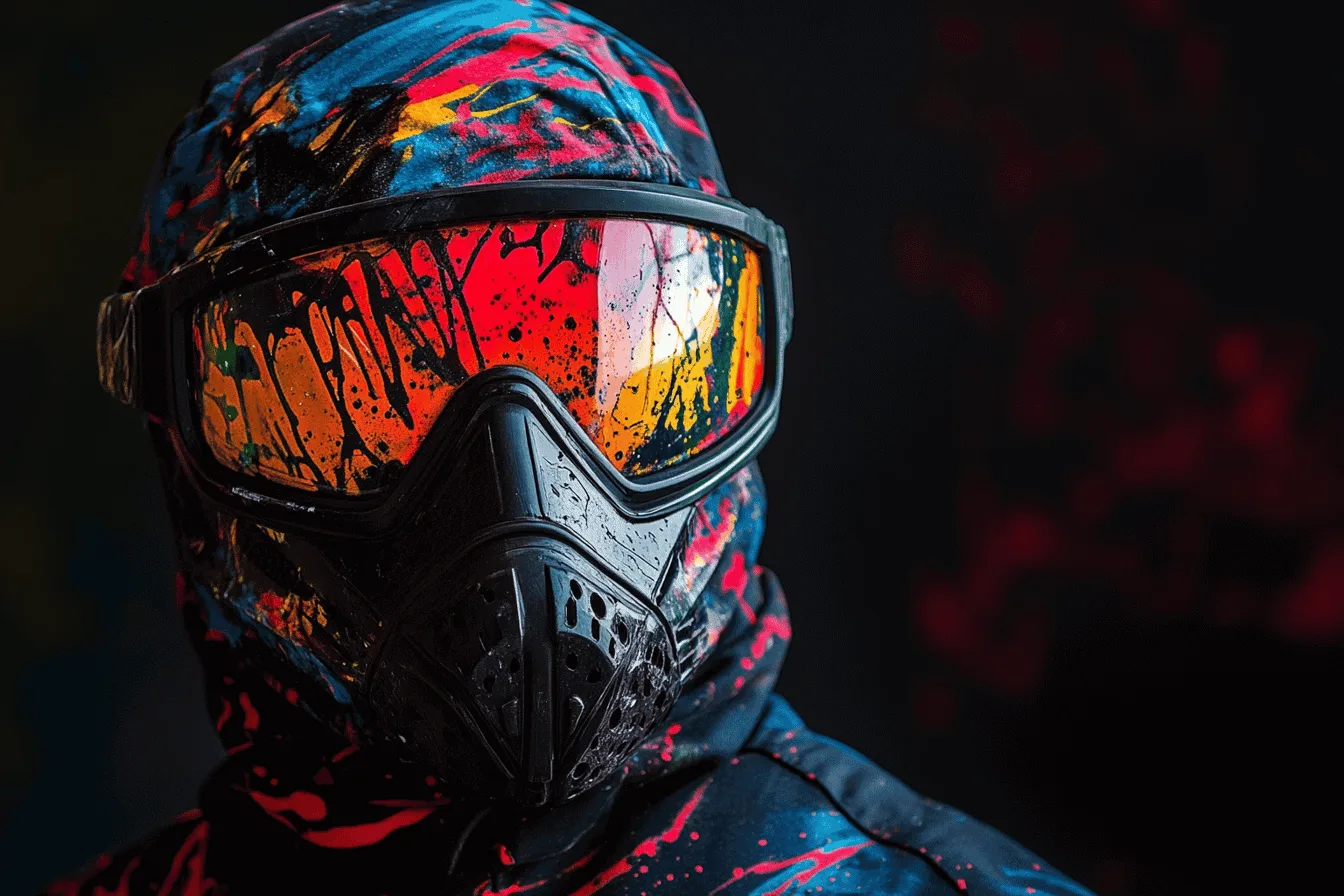
Eye protection represents the single most critical safety requirement in paintball. Paintballs traveling at field-legal velocities can cause serious eye injuries including blindness. All players must wear approved masks or goggles throughout play.
Paintball masks must meet ASTM F1776 standards, the industry specification for paintball eye protection. Approved masks use impact-resistant lenses designed to withstand direct paintball hits without failure.
Full-face masks offer maximum protection, covering eyes, ears, and lower face. Players at commercial facilities typically must use full masks. Some experienced players prefer lower-profile goggles for competitive play, but these offer reduced protection and may not be permitted at all facilities.
Body Protection Options
Beyond mandatory eye protection, players can choose various body protection options based on comfort, playing style, and personal preference. Padded jerseys and pants reduce impact pain from hits. Chest protectors provide additional coverage for sensitive areas. Neck protectors and gloves round out common protective gear.
Beginning players often appreciate more padding as they acclimate to being hit. Experienced players frequently reduce protection as they become comfortable with impacts and prioritize mobility. Most commercial facilities do not require body protection beyond masks but recommend appropriate coverage.
Barrel Blocking Devices
Barrel blocking devices prevent accidental discharges when markers are not in active use. These come in two main forms: barrel plugs that insert into the barrel opening, and barrel socks or sleeves that cover the barrel end.
Commercial facilities require barrel blocking devices whenever players are not on active playing fields. This includes staging areas, equipment zones, and anywhere masks are not mandatory. Proper blocking device use prevents injuries from accidental discharges.
Getting Started in Paintball
For newcomers interested in trying paintball, several pathways offer safe, legal introduction to the sport. Starting at commercial facilities provides the best experience while ensuring compliance with all applicable regulations.
Finding Local Paintball Fields
Commercial paintball facilities operate throughout the United States, offering various game formats and experience levels. Searching "paintball field" with your city or region identifies local options. Most facilities maintain websites with information about pricing, hours, game types, and rental equipment availability.
Walk-on play at commercial fields provides the easiest entry point for beginners. These open sessions allow individuals or small groups to join games without organizing full teams. Facilities provide rental equipment including markers, masks, and basic paintballs.
Understanding Field Safety Rules
Commercial paintball facilities enforce comprehensive safety rules designed to prevent injuries and ensure fair play. Understanding these rules before arriving helps new players feel comfortable and prepared.
Common field rules include mandatory mask use in all playing areas, velocity limits on markers (typically 280-300 feet per second), surrender rules for close-range encounters, calling hits honestly, and barrel blocking device requirements in safe zones.
Fields typically offer safety briefings for new players covering all rules and procedures. Paying attention during these briefings and asking questions about anything unclear helps ensure a safe, enjoyable experience.
Equipment Progression for New Players
Beginning players should rent equipment for their first several outings before purchasing their own gear. Rental allows experimentation with different marker types while confirming genuine interest in the sport. The cost of purchasing quality equipment makes sense only after establishing paintball as a regular activity.
When ready to purchase, begin with safety equipment. A quality mask represents the most important investment, as it affects comfort, visibility, and protection throughout every game. Budget masks often fog badly, have limited peripheral vision, and fit poorly.
Markers range from entry-level mechanical models under $100 to high-end electronic tournament guns costing thousands. New players benefit from starting with reliable, simple markers that require minimal maintenance while developing skills.
Frequently Asked Questions About Paintball Gun Legality
Common questions about paintball gun laws deserve clear, direct answers. The following addresses issues that players frequently encounter.
Can I carry a paintball gun in my car?
Yes, in most states you can transport a paintball gun in your vehicle while traveling to and from legitimate paintball activities. However, you should take precautions: unload the marker, remove gas sources, and store it in a case or bag. Some states require the marker to be inaccessible from the passenger compartment, such as in a locked trunk.
Avoid making unnecessary stops with paintball equipment visible, and never brandish or display a paintball gun in public while traveling. If stopped by police, inform the officer calmly that you have paintball equipment in the vehicle before they discover it.
Is it legal to shoot paintballs in my backyard?
Legality depends on local ordinances and your specific property situation. Many municipalities prohibit discharging projectile weapons, including paintball guns, within city limits. Even where technically legal, noise and safety concerns may create problems with neighbors or authorities.
If you have sufficient private property in an area without discharge restrictions, backyard paintball can be legal. Ensure adequate backstops to prevent paintballs from leaving your property, and consider neighbors' comfort with the activity. Some homeowners' associations prohibit activities that might disturb neighbors regardless of municipal law.
Do paintball guns require serial numbers?
Federal law does not require paintball guns to have serial numbers because they are not classified as firearms. However, many manufacturers voluntarily serialize their products for warranty tracking and anti-theft purposes.
Some states may have specific requirements for identifying marks on air-powered devices. Check local regulations if you plan to modify or build paintball markers.
Can I order paintball guns online?
Yes, online paintball gun purchases are legal throughout the United States for adults meeting state age requirements. Reputable online retailers verify age during checkout and may require signature confirmation upon delivery.
State and local regulations still apply to online purchases. Buying a paintball marker online does not exempt you from licensing requirements in states that impose them. Ensure you understand and comply with all applicable regulations before ordering.
What happens if police stop me with a paintball gun?
Remain calm and cooperative if stopped while transporting paintball equipment. Inform the officer about the paintball gear before they discover it themselves. Keep your hands visible and avoid making sudden movements toward the equipment.
Having the marker unloaded, degassed, and properly cased demonstrates responsible ownership and compliance with transportation best practices. If you're traveling to or from a legitimate paintball activity, explain this clearly.
In most cases, officers will simply verify the equipment is properly secured and allow you to continue. However, if you're in a jurisdiction with stricter regulations, improper storage or suspicious circumstances could lead to further investigation or citations.
Conclusion
Paintball gun legality varies significantly across jurisdictions, making it essential for players to understand the specific regulations that apply in their area. While federal law treats paintball markers as sporting equipment rather than firearms, state and local regulations can impose meaningful restrictions on purchase, possession, transportation, and use.
The key principles for legal paintball participation include purchasing from licensed retailers and meeting age requirements, understanding your state's classification of paintball guns, transporting equipment properly with markers unloaded and cased, using paintball guns only at authorized locations, and following all safety rules and field regulations.
By approaching paintball with awareness of legal requirements and commitment to safe practices, players can enjoy this exciting sport without running afoul of the law. When in doubt about specific regulations, consulting local authorities or legal counsel provides definitive guidance for your situation.
Paintball offers tremendous recreational value, combining physical activity, teamwork, strategy, and excitement in ways few other sports match. With proper attention to legal compliance and safety, players of all experience levels can participate confidently and responsibly.
Additional Resources
- Consumer Product Safety Commission (CPSC) offers guidance on recreational equipment safety standards
- ASTM International maintains safety specifications for paintball protective equipment
